Conroe isn’t alone
Across Texas, cities and counties are ending their Flock contracts or putting the question directly to voters. Here’s what’s happening elsewhere in the state, updated as we find it.
We still need signature collectors
Quick reminder, please sign up for a shift collecting signatures at early voting! We still have open slots and need to fill every one. October 19 to 30, 2026, Conroe Central Library.
 Click to enlarge
These shifts currently have zero Petition Signature Volunteers signed up:
- Tue 10/20: 8:00am–12:30pm, 12:30pm–5:00pm
- Thu 10/22: 8:00am–12:30pm
- Fri 10/23: 12:30pm–5:00pm
- Sat 10/24: 11:00am–3:00pm, 3:00pm–7:00pm
- Sun 10/25: 2:00pm–5:00pm
- Mon 10/26: 11:00am–3:00pm, 3:00pm–7:00pm
- Tue 10/27: 7:00am–11:00am, 11:00am–3:00pm, 3:00pm–7:00pm
- Wed 10/28: 7:00am–11:00am, 11:00am–3:00pm, 3:00pm–7:00pm
- Thu 10/29: 7:00am–11:00am, 11:00am–3:00pm
- Fri 10/30: 7:00am–11:00am, 3:00pm–7:00pm
That's 19 shifts with nobody signed up at all, including every single shift on October 27 and 28. If you can take any of these, it makes a real difference.
A couple things to keep in mind once you're out there:
During early voting, most people walking up are going to assume anyone standing outside is campaigning for a candidate, so they may try to avoid the tent. Most aren't going to walk up and ask what we're doing either. We have to be proactive and talk to people as they walk by.
Something as simple as this is usually enough to get someone to stop and listen:
"We're not asking you to vote for anyone. We're collecting signatures to get Flock on the ballot so Conroe voters can decide if they want it or not."
So please grab a shift. We need people actually out there talking to voters and collecting signatures, not just waiting for them to come to us.
Who can collect signatures: you must be both a registered voter and someone who lives inside Conroe city limits (a Conroe mailing address alone doesn't qualify). If you're outside the city, you can still help, there are info tent, greeting, setup, voter outreach, and check-in roles that don't require you to live inside city limits.
We're also looking at organizing a petition signing event before early voting starts, more details on that soon.
What Conroe’s own data shows
Straight from the department’s own presentations and public records, including a discrepancy worth asking your council member about directly.
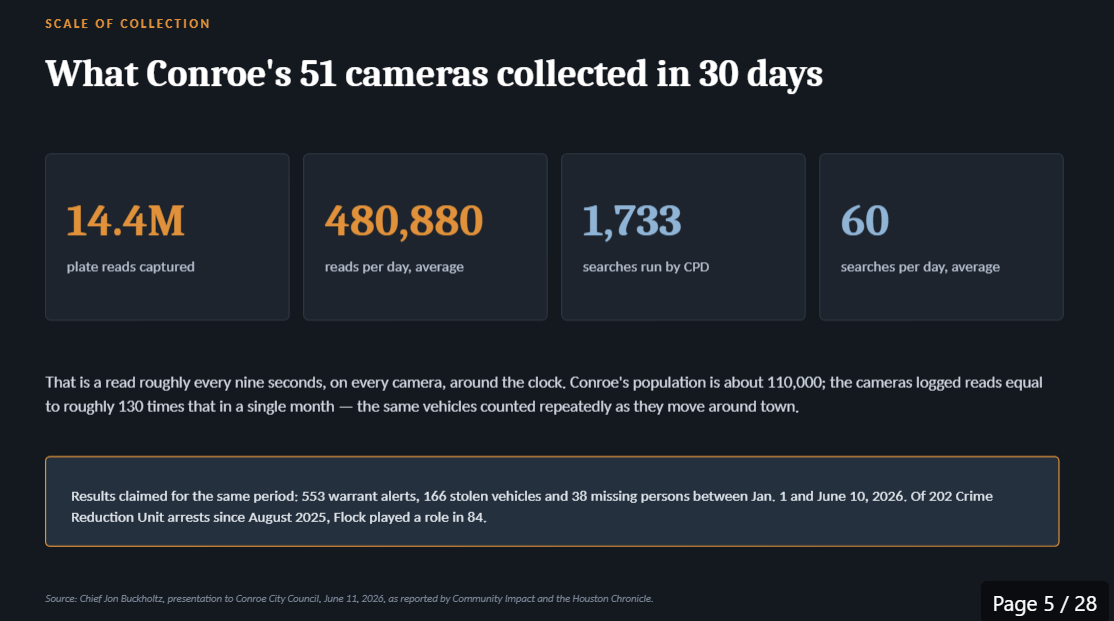
Source: Chief Jon Buckholtz’s presentation to Conroe City Council, June 11, 2026, as reported by Community Impact and the Houston Chronicle.
A discrepancy worth asking about
Two very different sets of numbers, three months apart.
Why this matters:
- The two figures use different units, total reads versus “unique scans,” and no public document defines the second term or its time window.
- The smaller framing makes the collection footprint look about 16 times lighter than the department’s own June figure.
- A reasonable question for Council: which number describes how many times a Conroe resident’s car was photographed last month, and over what period?
Sources: Community Impact, June 15, 2026; KPRC Click2Houston, Sept. 11, 2026. The discrepancy is noted here as an open question, not an allegation.
Want the full county picture, not just Conroe's own numbers?
The Texas Privacy Coalition maintains a county-by-county evidence file on ALPR cameras, including a review of Conroe's own Flock authorization trail (a council resolution plus TxDOT agreement dated Oct. 12, 2023, and a later five-year contract totaling $637,500), plus 271 community-mapped cameras and 9 listed agencies across all of Montgomery County.
See the Montgomery County evidence file →Right here at home
Willis shuts its whole network down
Willis switched off its entire Flock camera network until further notice. Mayor William Brown said the city’s “tools and technology must be appropriately reviewed” and that residents’ concerns “must be heard,” part of a wave that’s also hit Pflugerville, Bastrop, Elgin, Manor, and Leander.
Read the story →Just up the road: Magnolia cancels, too
Magnolia recently canceled its own Flock contract, according to Houston Chronicle reporting on the statewide backlash.
Read the story →Montgomery ISD Police Department, confirmed Flock use
Public-record data identifies the district’s police department as a Flock ALPR user; procurement details (cost, camera count, board vote) haven’t been located yet.
Read the story →Montgomery County MUD 94, proposal deferred
The board considered a Flock proposal at a special meeting, discussed cost with a county constable and Flock reps, and twice deferred taking action.
Read the story →County constable deputy, fired and arrested
Louis Norman, a two-year Precinct 3 Constable’s Office deputy, was fired and arrested for misuse of official information, a third-degree felony. He allegedly searched names, addresses, and license plate information to stalk a former girlfriend.
Read the story →Mayor Coon says death threats posted on Facebook
Mayor Duke Coon says Conroe police are investigating a Facebook comment threatening council members over the city's Flock program, which he says read in part, "Be prepared to physically unalive at least half of them." It follows council members' claims in August of phone threats and harassment, also without public documentation. Coon says the threats haven't changed his position: "I support Flock. My chief supports Flock. Our officers support Flock."
Read the story →Residents petition for a special election
James Fletes is gathering roughly 1,300 signatures on a citizen-drafted ordinance to force a special election on Flock, after Council voted in August against putting the question on the ballot itself.
Read the story →Harris, Galveston, Brazoria, and Fort Bend counties
Manvel votes 6-0 to end its contract
After an hours-long public hearing, council voted unanimously to end the city’s Flock contract, directing staff to send a 30-day cancellation notice and cover all 16 cameras within 24 to 48 hours.
Read the story →League City, camera question going to voters
City Council placed a non-binding referendum on the ballot asking whether police should keep using fixed Flock cameras. Mayor Nick Long: “If the citizens don’t trust that it can be [used safely], then they need to come down.”
Read the story →Katy, former Officer Sergio Rodriguez
Allegedly used Flock to track his ex-partner more than 2,000 times over about 11 months. Fired, arrested, and indicted; he has pleaded not guilty.
Read the story →Pasadena, former Sgt. Michael Palitz
Allegedly used Flock to track and stalk a fellow officer. Resigned during the investigation and surrendered his peace-officer license rather than face prosecution.
Read the story →Fort Bend County, a sheriff’s lieutenant
Used Flock to monitor multiple people, including someone in a contentious family relationship. Suspended for two days.
Read the story →Deer Park, 165 searches, one plate, seven months
An internal audit found Officer Brandon Williams searched the same plate 165 times over seven months for reasons unrelated to any investigation. He admitted it, and admitted it violated policy. Suspended 10 days and reassigned; prosecutors declined to pursue it criminally.
Read the story →Baytown, internal and criminal investigation
An officer accused of misusing the city’s Flock system prompted the chief to open a criminal investigation alongside the internal-affairs case, and to call in the Harris County DA’s office. The officer resigned.
Read the story →Harris County, 3 deputies, access cut after a reporter asked
The Sheriff’s Office suspended three deputies’ Flock access after a news inquiry raised questions about their use of the system. Investigation ongoing; the deputies haven’t been named.
Read the story →Harris County, special meeting on Flock oversight
County Judge Lina Hidalgo set a 9am special Commissioners Court meeting for October 15 to hear from the public, law enforcement, and Flock vendors, after the Court quietly passed a $2 million, one-year contract extension she abstained from. The Sheriff's Office has quoted $121,000 just to produce records on how the system is used.
Read the story →Statewide news
Even the Governor is hitting pause
Gov. Greg Abbott ordered Texas state agencies to stop funding Flock cameras amid growing privacy and misuse concerns. The state has already put at least $30 million behind the network since 2023.
Read the story →Flock offers to self-fund cameras through the freeze
Betting Abbott restores funding after the election, Flock is covering 90 days of payments itself so agencies like Dallas, Addison, New Braunfels, and Johnson County can keep state-grant-funded cameras running, with no penalty to exit if funding doesn't return.
Read the story →Wylie ends its Flock contract, 7-0
City council voted unanimously not to renew, with the contract expiring October 31. Mayor Matthew Porter cited “misuse by other departments” that partner with the city as his core concern, not Wylie’s own use.
Read the story →Pflugerville shuts off all 28 cameras
City council voted unanimously to terminate its Flock agreement after discovering non-partner law enforcement agencies had unauthorized access to the city’s camera data.
Read the story →Hood County: “Come get your garbage”
Commissioners voted to terminate their Flock contract; three cameras were unplugged and covered pending removal. Constable John D. Shirley: “Privacy isn’t optional, and mass surveillance isn’t how we do things here.”
Read the story →Kendall County commissioners say no, unanimously
Commissioners Court voted not to renew its Flock Safety contract following months of resident pushback over automated license plate readers.
Read the story →San Marcos lets its contract lapse
City council chose not to renew, allowing the Flock agreement to expire rather than continue the program.
Read the story →Lago Vista votes to remove Flock cameras
City council voted unanimously to end its use of automated license plate readers and terminate its Flock agreement.
Read the story →Austin lets its Flock program lapse
City council didn’t renew after an audit raised documentation and data-sharing concerns, one of the biggest cities in the state to walk away.
Read the story →Guadalupe County: not worth the cost
Commissioners approved early termination; the sheriff cited vandalism, cost, and public scrutiny. Canceling early still cost the county about $8,500.
Read the story →Bandera: months of pushback pay off
Council voted 3-2 to terminate its Flock contract after sustained public opposition, the same pressure campaign playing out in Conroe.
Read the story →Hays County commissioners pull the plug
Commissioners voted 3-2 to terminate all of the county’s Flock contracts after months of discussion.
Read the story →Ingleside: privacy concerns end it early
City council voted unanimously to pull the plug on its Flock contract after residents raised privacy concerns.
Read the story →Aransas Pass cancels after pushback
City council voted to cancel its Flock contract following community pushback.
Read the story →Liberty Hill removes every camera
Council voted unanimously to end its contract rather than let it auto-renew, and directed staff to remove the cameras immediately. All seven were pulled down within a week, and the city adopted a policy against using technology for mass surveillance going forward.
Read the story →Burnet County pulls its fixed cameras
After two cameras were vandalized, the sheriff’s office removed every fixed Flock camera countywide. The contract itself isn’t fully ended yet.
Read the story →Lufkin, Officer Zachary Klein, 10,000+ searches
Indicted on 100 felony counts after an arrest affidavit alleged he searched Flock more than 10,000 times to track an ex-girlfriend, her relatives, and people connected to her. Lufkin PD suspended its entire Flock program.
Read the story →Johnson County, a nationwide search, no warrant, “had abortion”
A deputy searched Flock’s full nationwide network, more than 83,000 cameras, to locate a woman, with the stated search reason logged as “had abortion, search for female.” The sheriff’s office disputes that characterization; no charges were filed after a medical examiner found no fetal material.
Read the story →Statewide, at least 56 cities and counties deactivated, rejected, or canceled Flock contracts in 2026 alone. Newsweek is tracking the map, and the Institute for Justice tracks contract cancelations nationwide (137+ as of late August 2026).
Errors, abuse, and Congress taking notice
Beyond Texas, a growing nationwide count from the Institute for Justice and other public records has documented dozens of police employees fired, arrested, suspended, or investigated for personal Flock searches, plus real people held at gunpoint or jailed over misreads, and now direct scrutiny from both chambers of Congress.
Savannah, GA, six employees terminated
A department’s own audit found Flock searches with no legitimate law-enforcement purpose, including personal acquaintances and family. All six were fired; a state criminal investigation is ongoing.
Read the story →Indianapolis, IN, 3,759 searches in 10 months
An officer reportedly ran nearly 3,800 Flock searches on vehicles tied to his wife and two acquaintances. Suspended without pay; the department has recommended termination.
Read the story →Federal judge: Flock search was "indiscriminate mass surveillance"
A Tulsa County deputy used Flock and VehicleManager to pull 50+ location records on a California-plated car over roughly 30 days with no warrant and no individualized suspicion. U.S. District Judge Sara Hill ruled it an unconstitutional Fourth Amendment search and suppressed the evidence. It's not binding precedent, but it's one of the first federal rulings to go against Flock.
Read the story →Brandon Upchurch
A “7” misread as “2.” Held at gunpoint, mauled by a police K-9, jailed. Charges dropped. City settled for $35,000.
Read the story →Lindsey Isaacs, 13 days in jail over a misread
A Flock hit near a fatal triple hit-and-run led to 8 felony charges and 13 days in jail. Her Durango had no damage; the real suspect, driving a different Durango, was arrested later. She went on to testify before the Senate about the ordeal.
Read the story →Jason Burkleo
Dirt on his plate made an “H” read as “M,” flagging his car as stolen. Stopped at gunpoint, handcuffed on the ground. Settled for $45,000.
Read the story →Steven Melvin
One misread letter flagged his BMW as stolen. Held at gunpoint, ordered to kneel for over five minutes. No charges filed; he’s now suing.
Read the story →Joel Feder
A loaner Range Rover’s plate was misread against an LAPD-entered stolen tag. Boxed in by four squad cars in a Kohl’s parking lot, detained about an hour.
Read the story →A young family
A bent plate frame obscured one letter, matching a stolen-vehicle alert. Both parents were cuffed at gunpoint while their six-week-old stayed alone in the car seat.
Read the story →Brittney Gilliam and family
An SUV plate was matched to a stolen motorcycle registered in another state. Gilliam and four children, ages 6-17, were held at gunpoint in a parking lot. The city later paid $1.9 million.
Read the story →JC and Carolyn Herron
Carolyn’s nurse plate, “LOVEY,” was misread as the stolen plate “L0VEY.” Both grandparents were cuffed at gunpoint while their 3-year-old granddaughter watched from the car.
Read the story →LAPD drops Flock entirely
An internal audit found 161 false stolen-vehicle alerts in two months, a 32.3% error rate on “hot list” hits. LAPD let its contract expire rather than renew.
Read the story →71% of high-stakes alerts were wrong
Of 1,427 alerts flagging vehicles as stolen or felony-linked, 71% were plate misreads. One driver was wrongly flagged six times. Flock advertises 99% accuracy.
Read the story →Sen. Hawley chairs a hearing on Flock
The Senate Judiciary Subcommittee on Crime and Counterterrorism held a hearing titled “Always Watching: Flock’s Nationwide AI Surveillance Network.” Flock’s own Chief Legal Officer had already conceded, in a letter to the committee, that “Americans’ privacy should[n’t] depend on one vendor’s good judgment, its current leadership, or its commercial incentives.”
Read the story →Senators press Flock’s CEO for answers
Sens. Adam Schiff and Ron Wyden sent Flock CEO Garrett Langley a letter demanding answers on how the company prevents officers from entering false search justifications, and when its proactive misuse-lockout system becomes mandatory for police customers.
Read the story →Formal investigation into Flock Group Inc.
Reps. Raja Krishnamoorthi and Robert Garcia opened a formal investigation into Flock over reports its “National Lookup” tool let a Texas sheriff’s office search over 6,800 networks and 83,000+ cameras nationwide for a woman based on the query “had an abortion, search for female.”
Read the story →Bipartisan “No FLOCK Act” introduced
H.R. 10366 would give states two years to limit ALPR use to five narrow purposes (stolen vehicles, missing persons, felony warrants, and the like) or lose 10% of certain federal highway funding. It followed a Washington Post investigation identifying 69+ officers accused of abusing these systems.
Read the story →The “Flock-Off Act”
H.R. 10221 would go further than the No FLOCK Act, banning federal funds for automated license plate readers and biometric surveillance for local law enforcement entirely, with narrow exceptions for the border and tolling.
Read the story →FLAFO Act would require a warrant
Prompted by a Sarasota, FL officer accused of running one license plate through Flock over 350 times, the FLAFO Act would bar federal agencies from accessing ALPR data without a judicial warrant, with criminal and civil penalties for violations.
Read the story →Full case list and methodology: Institute for Justice, “Dozens of Innocent Motorists...”